

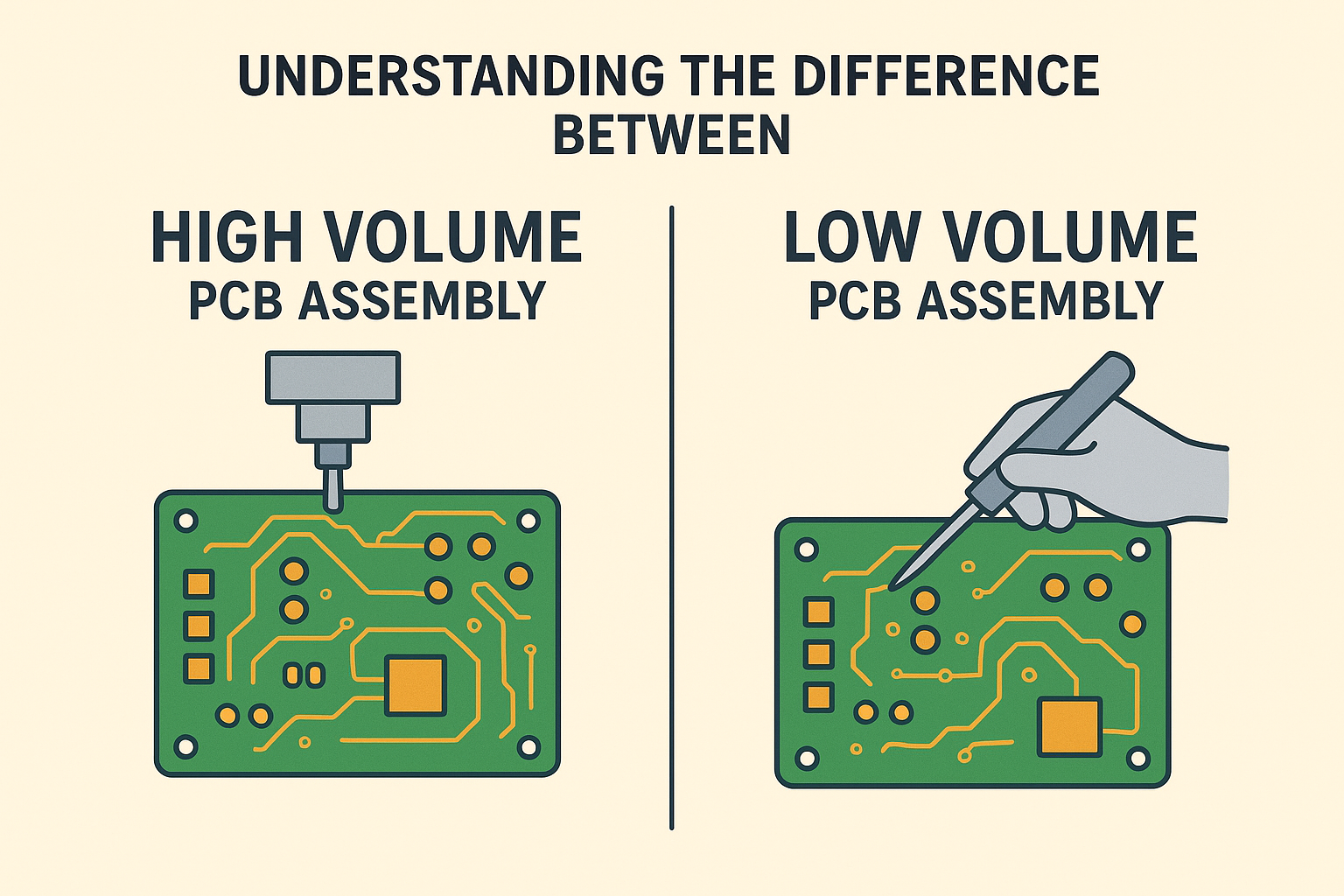
The modern electronic devices rely on printed circuit boards (PCBs), which hold the components and provide smooth electrical connectivity. The manufacturing world comprises two major production magnitudes that take the lead in the manufacturing world that is, High Volume PCB Assembly and Low Volume PCB Assembly. The two serve varied purposes in the electronics industry and serve various needs based on the size of production, product level and customer demand.
What Is High Volume PCB Assembly?
High-Volume PCB Assembly A large-scale manufacturing of printed circuit boards usually that of thousands and sometimes millions of phases. This model best fits with products that are already in the market and have tested designs. It is concentrated on speed, accuracy, and efficiency, and relies on automated soldering, placement machines and inspection.
Large-volume manufacturers are dependent on surface-mount technology (SMT) and sophisticated automation equipment to ensure that all units are consistent. Companies can enjoy the economies of scale through large-scale production, which makes the cost per unit of production lower. This efficiency, however, can only be realized by a very big setup, quality control measures and optimization of supply chain management to deliver on time and have availability of components.
Advantages of High-Volume PCB Assembly
Cost-effectiveness is one of the largest advantages of High Volume PCB Assembly. When you make a thousand boards at once, the cost of procuring materials, setting up machines, and testing is shared among the whole batch, making the total cost per unit low.
Also, it has automated processes that provide uniform quality, which is essential in mass-market electronics like smartphones, home appliances, and automobile control systems. The other benefit is that the turnaround time will be lower after optimization of the production line. Once set up, manufacturers can quickly make the same PCBs, and so the supply can be easily provided to satisfy increasing market demand.
What Is Low Volume PCB Assembly?
Low-Volume PCB Assembly, on the other hand, deals with small batches, between a few and several hundred units. The process is best suited to prototypes, custom designs, and pilot production before the start of full-scale production. This approach to test designs is preferred by startups, research teams and product developers to test their designs, validate their performance, and detect any problems before committing to large-scale production.
Low-volume PCB Assembly is more flexible because a batch of customization might be required. The engineers can make corrections in their designs, select specialized components, and even test other layouts without a huge implication on cost. This is aimed at quality and flexibility, and not volume efficiency.
Advantages of Low-Volume PCB Assembly
The important benefit of Low Volume PCB Assembly is the flexibility. It enables manufacturers to react fast to the design changes and the market responses. Low-volume production can be used when the new product is being tested to make improvements through trial and error without huge financial implications.
The other advantage is improved prototyping. The time lag between the completion of design and actual delivery of the physical prototype is greatly minimized because setup and tooling requirements are minimal. This simplifies the process of developers accelerating product innovation. Moreover, as the run sizes are reduced, quality control teams can scrutinize the boards closely, and the quality will be extremely high in production at the early stages.
Conclusion
Both the PCB assemblies are part of the electronic manufacturing ecosystem. All of them have their strengths and weaknesses, as well as specific uses. Low volume assembly creates flexibility and innovation of new design, whereas high-volume assembly is cost-effective and reliable in mass production. Companies need to assess their project objectives, demand, and schedules very well in order to select the most appropriate approach. To enjoy quality and innovation in the electronics sector, reliability, accuracy and efficiency in PCB manufacturing solutions acceptable to both the large and small scale production, rely on a name LYRTION.