
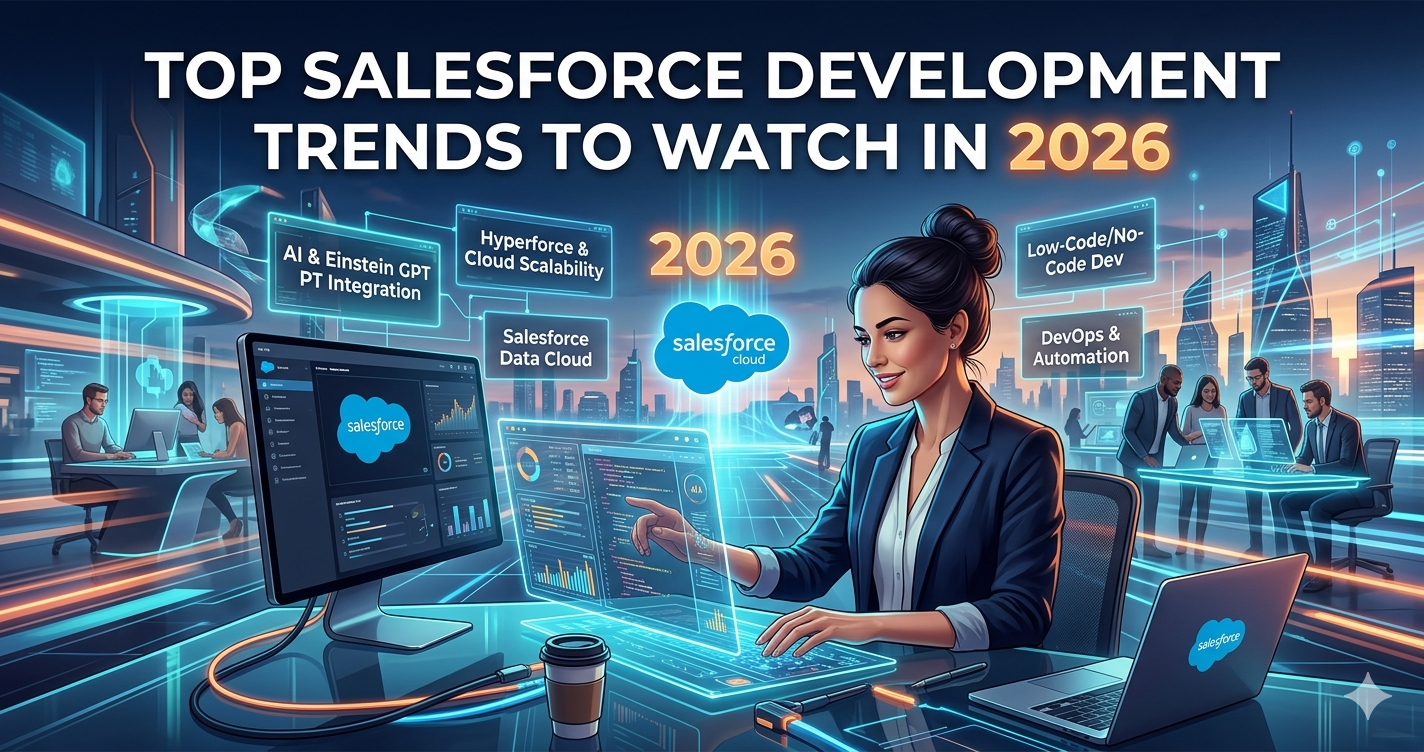
Salesforce continues to play a central role in enterprise digital infrastructure, and its ecosystem is expanding rapidly. According to IDC, global spending on digital transformation is expected to reach over $3.9 trillion by 2027, with CRM platforms like Salesforce driving a significant portion of that investment. Gartner also reports that CRM remains the largest software market worldwide, with revenue surpassing $100 billion in recent years. Additionally, Salesforce’s own ecosystem is projected to create over 9 million new jobs globally by 2026.
These numbers reflect a clear direction: organizations are investing heavily in scalable, cloud-based customer platforms. As a result, businesses increasingly rely on a specialized Salesforce Development Company or internal teams offering Salesforce Development Services to build tailored, high-performance solutions. Understanding the upcoming development trends is essential for technical leaders, architects, and developers who want to stay relevant in 2026.
1. AI-Driven Development with Einstein and Generative AI
Artificial intelligence has moved beyond basic automation. In 2026, Salesforce development focuses heavily on AI-assisted workflows and predictive capabilities.
Salesforce Einstein and generative AI tools now support:
- Code suggestions for Apex and Lightning Web Components (LWC)
- Automated testing recommendations
- Intelligent customer insights embedded directly into workflows
Developers are no longer writing everything manually. Instead, they supervise AI-generated outputs and refine logic. This shift reduces development time while increasing accuracy.
A Salesforce Development Company now prioritizes AI integration as a core service, not an optional feature. Teams that understand prompt engineering and AI governance will hold a strong advantage.
2. Rise of Low-Code and Pro-Code Hybrid Development
Low-code tools such as Flow Builder and App Builder continue to mature. However, enterprises still require deep customization that only code-based approaches can deliver.
The trend in 2026 is hybrid development:
- Admins handle workflows using low-code tools
- Developers extend functionality using Apex, LWC, and APIs
- Both layers work together without conflict
This approach reduces bottlenecks between teams. It also ensures faster delivery without sacrificing flexibility.
Organizations now expect Salesforce Development Services to balance both approaches effectively. Teams that rely only on low-code or only on custom code often struggle to scale.
3. API-First and Integration-Centric Architecture
Modern enterprises operate across multiple platforms. Salesforce no longer acts as a standalone system; it serves as part of a larger digital ecosystem.
In 2026, developers follow an API-first strategy:
- Every function is exposed as a reusable service
- Integration with ERP, IoT, and external analytics platforms becomes standard
- Middleware tools such as MuleSoft remain critical
This shift supports:
- Faster system communication
- Better data consistency
- Easier upgrades and scalability
A Salesforce Development Company must now design systems with integration in mind from day one. Poorly planned integrations often lead to performance issues and data silos.
4. Industry-Specific Salesforce Clouds
Salesforce has expanded its industry-specific solutions, including:
- Financial Services Cloud
- Health Cloud
- Manufacturing Cloud
- Retail Cloud
These platforms provide pre-built data models, workflows, and compliance features.
In 2026, development teams focus more on:
- Customizing industry clouds rather than building from scratch
- Extending standard objects with minimal disruption
- Maintaining compliance with sector-specific regulations
This approach reduces development time while ensuring better alignment with industry standards.
5. Lightning Web Components (LWC) Dominance
Lightning Web Components have become the standard for front-end development in Salesforce. Aura components are gradually declining in usage.
LWC offers:
- Better performance due to native browser capabilities
- Cleaner and modular JavaScript architecture
- Easier integration with modern web standards
In 2026, most UI development relies on LWC. Developers who still depend heavily on older frameworks face limitations in scalability and maintainability.
Salesforce Development Services now emphasize:
- Component reusability
- Clean UI/UX design
- Performance optimization
6. Data Cloud and Real-Time Data Processing
Data has become the backbone of every Salesforce implementation. Salesforce Data Cloud enables real-time data unification across multiple sources.
Key capabilities include:
- Real-time customer profiles
- Unified data from marketing, sales, and service systems
- Event-driven architecture for faster decision-making
Developers now design systems that process and respond to data instantly rather than relying on batch updates.
This trend supports:
- Personalized customer experiences
- Faster business decisions
- Improved operational efficiency
7. DevOps and Continuous Delivery for Salesforce
Traditional Salesforce deployments involved manual steps and risk-prone releases. In 2026, DevOps practices are standard.
Key elements include:
- Version control using Git
- Automated testing pipelines
- Continuous integration and deployment (CI/CD)
Tools such as Salesforce DevOps Center and third-party platforms help teams manage releases efficiently.
A Salesforce Development Company now treats DevOps as a necessity rather than an advanced capability. Teams that adopt CI/CD reduce errors and improve release speed significantly.
8. Enhanced Security and Compliance Focus
With increasing data privacy regulations, security has become a top priority.
Salesforce development now includes:
- Role-based access control
- Field-level security enforcement
- Data encryption and audit tracking
Developers must also consider global regulations such as GDPR and region-specific compliance laws.
Security is no longer handled only at the infrastructure level. Developers play a direct role in ensuring safe data handling within applications.
9. IoT Integration with Salesforce
As an IoT-focused perspective, integration between connected devices and Salesforce continues to grow.
In 2026:
- Devices send real-time data into Salesforce platforms
- Automated workflows trigger based on sensor inputs
- Predictive maintenance becomes more accurate
For example:
- Manufacturing companies monitor machine health
- Logistics firms track fleet performance in real time
- Healthcare providers collect patient device data
This trend requires strong expertise in APIs, event streaming, and data processing.
Real-World Enterprise Case Example
A global manufacturing company implemented Salesforce Manufacturing Cloud integrated with IoT sensors across its production lines.
Challenges:
- Frequent machine downtime
- Lack of real-time visibility
- Delayed maintenance decisions
Solution:
The company partnered with a Salesforce Development Company to:
- Integrate IoT data streams into Salesforce
- Build real-time dashboards using LWC
- Automate alerts for predictive maintenance
Results:
- Reduced downtime by 28%
- Improved production efficiency by 18%
- Lowered maintenance costs significantly
This example highlights how modern Salesforce Development Services extend beyond CRM and into operational intelligence.
Business Impact and ROI
Organizations investing in modern Salesforce development trends see measurable benefits.
Key ROI Indicators:
- Faster deployment cycles: Reduced by 30–50% with DevOps practices
- Improved productivity: Teams complete tasks more efficiently with AI-assisted tools
- Better customer retention: Real-time insights improve engagement
- Lower operational costs: Automation reduces manual work
Companies that adopt these trends early gain a competitive advantage. They respond faster to market changes and deliver better customer experiences.
Final Thoughts
Salesforce development in 2026 reflects a shift toward intelligent, connected, and scalable systems. AI integration, real-time data processing, and API-first design are no longer optional. They define how modern applications function.
A skilled Salesforce Development Company must combine technical depth with architectural clarity. Similarly, businesses seeking Salesforce Development Services should prioritize teams that understand both current tools and long-term scalability.
The focus has moved from simple CRM customization to building complete digital ecosystems. Developers who adapt to this shift will remain relevant, while those who rely on outdated practices will face limitations.
Read Also: How Free Apps Make Money in 2026